You Don’t Need a Certificate or a Title to Start Doing Peer Support
Over the past several months, I’ve had more and more responders pull me aside and say some version of the same thing:
“I want to get involved in peer support… I just don’t know where to start.”
That desire—to show up for others, to be a voice of calm in the chaos, to carry the weight together—is one of the clearest signs that someone’s ready for this work. But almost every time, what follows is a set of real, frustrating barriers:
- “I can’t find a class near me.”
- “I don’t know which training is the right one.”
- “Even if I find one, I’m not sure I can afford it.”
- “I took a class… but there’s no team near me that meets or trains.”
If that’s where you are, let me say something clearly:
You don’t have to wait until everything lines up to begin making a difference.
Peer support doesn’t start with a class. It starts with connection.
Training Matters—But It’s Not the Whole Picture
Of course, we absolutely need well-trained peer supporters. Training in critical incident stress, suicide prevention, and trauma-informed care gives us tools to respond well in moments of acute need. But peer support is bigger than a crisis team. It’s not just what happens after a line-of-duty death or a horrific call.
A lot of the real work happens in the in-between moments—
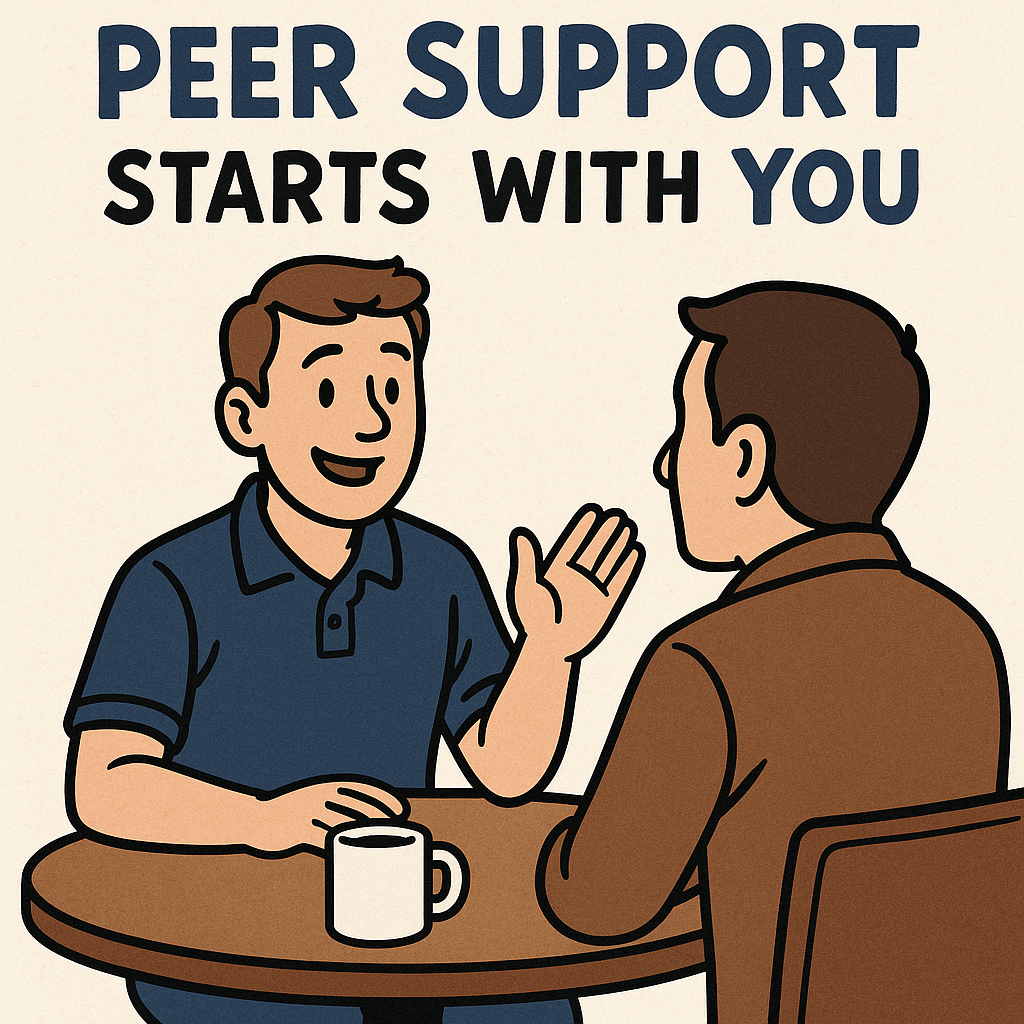
The coffee after shift.
The conversation in the parking lot.
The weekly check-in.
The stories shared in a circle where everyone nods, because they’ve been there too.
Those are the moments when peer support gets real.
When someone’s wall comes down—not because you had the perfect words, but because you were willing to sit there long enough to see past their armor.
Show Up and Share: That’s Peer Support Too
Sometimes the most powerful thing you can do is share your own story. Your struggles. The things you’re still figuring out. The things you’ve survived. When you show up with your humanity—especially in a space where others feel like they have to be invincible—you become a living reminder that they don’t have to do it alone.
And the beautiful thing is, you don’t have to build that space from scratch. There are groups meeting regularly—virtually and in person—that make room for this kind of connection and growth:
- 🛡️ SHIELD Recovery for Responders – Weekly and monthly meetings designed specifically for emergency and disaster responders. A space for honesty, healing, and strength. www.sc-rsi.org/shield
- ❄️ FROST Peer Group – A national virtual group that meets online and connects responders across the country in shared experience and mutual support. www.frostpeergroup.com
- 🔥 Lowcountry Firefighter Support Team – South Carolina-based in-person peer support gatherings, counseling, and resource connections for fire and EMS personnel. www.firefightersupport.org
- 🤝 People of Service Together (POST) Peer Group – Virtual peer support for all people of service, hosted by POST. www.peopleofservicetogether.org/peer-group
Of course, these are just a few of the many great options out there. If you’re part of another peer support group or know of one that’s helping others, please drop a link in the comments—someone reading this may need exactly what your group offers.
The Invitation Is Simple: Join Us
You don’t need a title. You don’t need permission. You don’t need a perfect recovery story. What you need is the willingness to be real, to keep showing up, and to sit with others in their realness too.
If you’ve felt the pull toward peer support, don’t wait for the stars to align. Start with your story. Start by joining a group. Start by being someone who listens.
Peer support starts in the everyday.
And it starts with you.
About the Author:
Tim Wojcik is a public safety chaplain, retired firefighter/paramedic, and the director of the South Carolina Responder Support Initiative (SC-RSI). With over three decades of frontline experience, he now focuses on building peer support, chaplaincy, and wellness programs for emergency and disaster responders across the state. Tim is passionate about creating spaces where responders feel seen, heard, and supported—not just in crisis, but in everyday life. Learn more about SC-RSI at www.sc-rsi.org.
 South Carolina - Responder Support Initiative
Leave a comment